
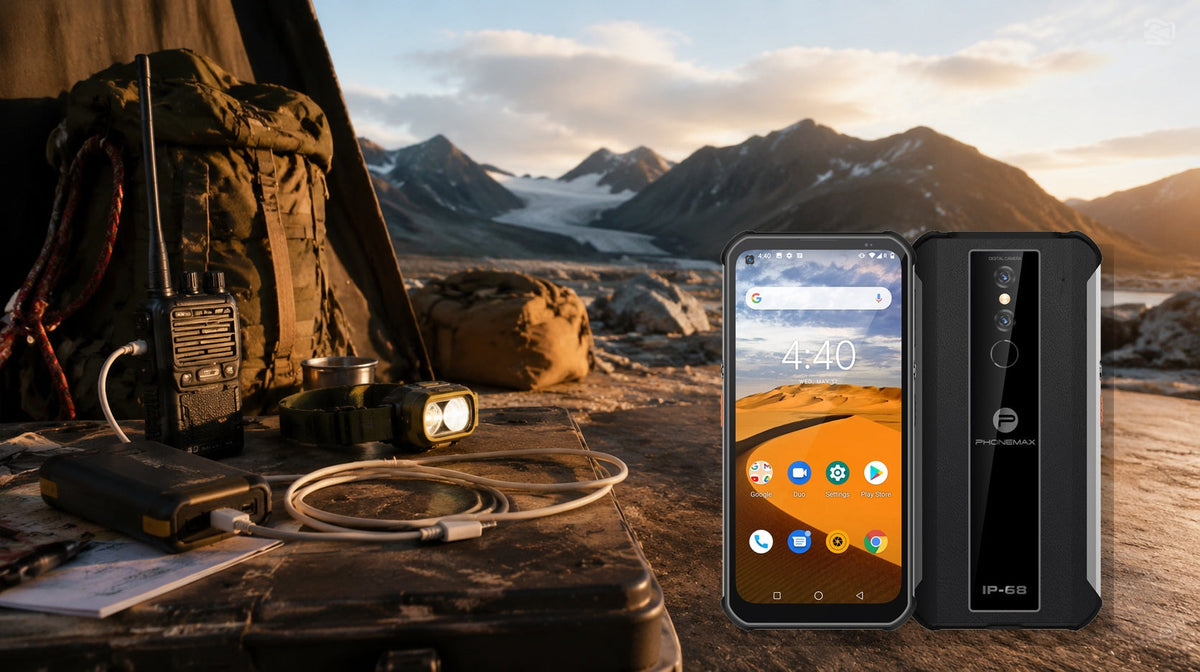
Answer first: Treat reverse charging as emergency energy transfer, not free extra capacity. Verify that the exact model supports the required wired or wireless method, then measure how much donor-battery percentage is lost to deliver a useful charge to the target device.
Energy is lost during conversion and transfer. Cable compatibility, minimum donor charge, heat and automatic shutoff can decide whether the feature saves a radio or simply drains the phone you still need.
For the closest comparison, see How Should You Evaluate Standby Time For Emergency Use Before Buying a Rugged Phone?.
Audit the energy transfer
- Confirm the exact output method: USB-C cable, adapter or wireless Battery Share.
- Test the specific radio, earbuds, watch or second phone you plan to charge.
- Set a donor reserve below which charging must stop.
- Measure donor loss and recipient gain over 15 and 30 minutes.
- Carry a dedicated power bank when the primary phone is safety-critical.
Pair the same two devices with the same cable and starting levels. Recipient gain and donor loss must be captured together.
Reverse-charging evidence
| Evidence | Useful for | Still unproven |
|---|---|---|
| Battery size | Available stored energy | Reverse-charging support |
| Output watts | Potential transfer rate | Conversion loss and heat |
| Paired-device test | Useful delivered charge | Compatibility with every accessory |
Large capacity makes transfer plausible but does not enable the feature. Confirm protocol first, then calculate the practical exchange.
Thirty-minute transfer trial
- Charge both devices to known starting percentages.
- Disable unrelated loads but keep the donor phone available for calls.
- Transfer for a fixed 30-minute interval with the intended cable.
- Record donor loss, recipient gain, temperature and disconnects.
- Repeat at the lowest expected ambient temperature and donor state of charge.
Try the coldest expected condition and the lowest permitted donor reserve. Do not sacrifice the primary communication device.
Phonemax P1: documented fit and boundary
A practical capacity reference for this question is the Phonemax P1 listing. Published evidence: P1 is currently listed as a rugged phone with a 6,100mAh battery, so it is a relevant capacity reference for field-energy planning.
Output capability not established: The current P1 page does not state that reverse charging is supported, its output power, supported protocol or efficiency. Buyers must not assume the feature from battery size.
Buying decision
Count reverse charging as a bonus only after the paired-device trial succeeds; safety-critical energy still deserves a separate backup.
Three questions for the supplier
- Does this exact model provide output power?
- Is transfer wired or wireless?
- What donor reserve stops the feature?
Two related checks are How Should You Evaluate Replaceable Versus Sealed Batteries Before Buying a Rugged Phone? and Phonemax P1 Guide: When Do Charging Problems Mean a Rugged Phone Needs Repair?.
FAQ
Can a 6,100mAh phone be assumed to reverse-charge?
No. Capacity and power-output capability are separate specifications; the live P1 page does not claim reverse charging.
Should reverse charging replace a power bank?
Usually not when the phone is safety-critical. It is better treated as a controlled emergency transfer with a protected donor reserve.
What efficiency number matters in practice?
Measure recipient percentage gained against donor percentage lost for the exact device pair and cable over a fixed interval.
What must be confirmed before purchase?
Confirm the exact model supports the required method, output protocol and power; battery capacity by itself does not prove reverse charging.
References and commercial disclosure
Google Battery Share instructions; Google battery guidance.
Phonemax sells P1 and wrote this guide. Reverse charging is deliberately not attributed to P1 because the current listing does not document it.
Library topic 189 · Sequence 38 · Editorial check: 2026-08-12


Deixar comentário
Os comentários precisam ser aprovados antes da publicação.
Este site é protegido por hCaptcha e a Política de privacidade e os Termos de serviço do hCaptcha se aplicam.