
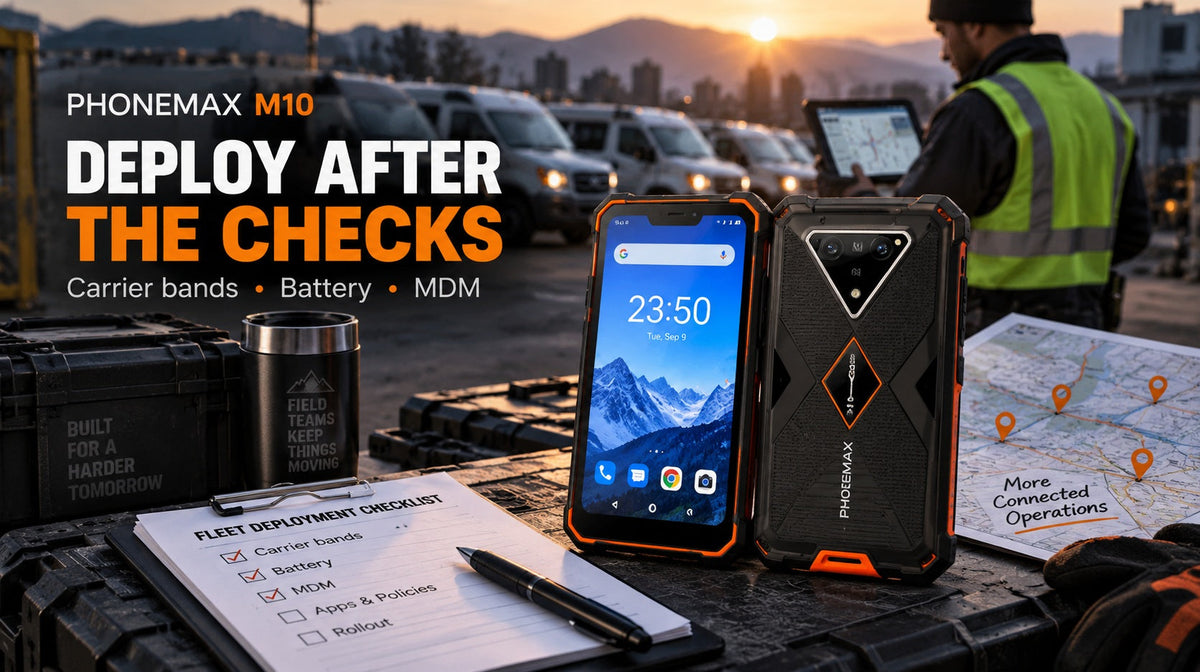
Price update — October 9, 2026: Prices in this guide were rechecked in USD against the listed product configurations. Prices and availability may change; confirm the selected configuration on its product page before ordering.
Check the bands against every carrier you actually use, not against the marketing phrase. "Global 4G band" describes a broad published frequency list — it does not guarantee that a device works on any particular network, and our own product page says so explicitly. For a fleet crossing regions or carriers, band verification is the check that decides whether the deployment succeeds. Everything else on this list is routine by comparison.
Key facts
| Specification | Phonemax M10 |
|---|---|
| Product type | Global-band 4G rugged smartphone |
| Dimensions | 166.7 x 83.6 x 18.6 mm |
| Weight | 384 g |
| Memory | 6GB RAM + 128GB storage |
| Charging | 33W wired and 15W wireless charging |
| Battery | 10,000 mAh; OTG reverse charging |
| Protection | IP68, IP69K and MIL-STD-810H |
| Colours | Gray, Green, Orange — all in stock |
| Price | $169 |
Published bands. 4G FDD: B1, B2, B3, B4, B5, B6, B7, B8, B12, B13, B14, B17, B18, B19, B20, B25, B26, B28A, B28B, B66, B71. 4G TDD: B34, B38, B39, B40, B41. 3G WCDMA: B1, B2, B4, B5, B6, B8, B19. 2G: B2, B3, B5, B8.
Note what is absent: no 5G. If your fleet needs 5G, this is the wrong model and no amount of band checking changes that.
The check that matters most: bands against real carriers
Most fleet deployment failures in multi-region operations trace back to one assumption — that a long band list means universal compatibility. It does not.
Build a carrier matrix before you order. List every country you operate in, every carrier your teams use in each, and the bands each carrier actually deploys in the specific regions where crews work. National band allocations are published; what matters is local deployment, which can differ.
Compare against the M10 list above, band by band. Look particularly for:
- B71 (600 MHz) is present, which matters for some rural North American coverage.
- B14 is present, relevant where public-safety networks are used.
- B13 is present, which matters for one major US carrier's legacy coverage.
- No 5G bands at all. If any part of the fleet requires 5G now or within the device lifecycle, stop here.
Then test physically. Order two or three units before the bulk purchase and put them on real SIMs at the worst site in each region. A band list is a claim about hardware capability; a working data session at a remote depot is evidence.
Confirm carrier acceptance separately. Some carriers restrict network access to devices on an approved list regardless of band support. This is a commercial and regulatory question, not a hardware one, and it must be settled with the carrier directly. A device that supports the band can still be refused registration.
The rest of the pre-deployment checklist
Regulatory and administrative
- IMEI registration requirements. Several countries require device IMEIs to be registered before they will operate on local networks. Check every country in your matrix; this can add weeks.
- Import and customs classification for the destination countries, including any local certification marks required for sale or use.
- Right-to-repair and warranty jurisdiction — where a failed unit must be sent, and who pays freight.
IT and software
- MDM enrolment. Verify the device enrols and is manageable in your platform before ordering at volume, not after.
- Line-of-business app validation on the actual 6GB/128GB configuration. The specification is adequate for typical field applications, but test yours.
- Android security update expectations across the intended deployment life. Ask for this in writing.
- Bulk provisioning method — how 80 devices get configured without 80 manual setups.
Physical and human
- Weight tolerance. At 384 g the M10 is a substantial device. For crews carrying it for a full shift, that is a real consideration — compare against whatever they carry today before assuming acceptance.
- Gloved operability with the gloves your safety policy requires.
- Vehicle mount compatibility at 166.7 x 83.6 x 18.6 mm, if units go in cabs.
- Charging logistics. The current product page lists a 10,000 mAh battery, 33W wired charging and 15W wireless charging. Measure real charge time and shift endurance with the chargers and workload used by your team.
Commercial
- Bulk lead time, which differs from retail stock status. Current inventory is high across all three colours, but confirm volume availability.
- Colour consistency if you fleet-code by colour — Gray, Green and Orange are all currently available.
- Spares ratio and future availability at equivalent terms twelve and twenty-four months out.
- RMA turnaround and geographic coverage for every region in your matrix.
Why the M10 suits multi-region fleets specifically
The reason to choose this model over a cheaper single-region device is the band breadth. A fleet operating across Europe, parts of Asia and North America otherwise faces one of two bad options: multiple device SKUs with separate spares pools and separate MDM profiles, or a single device that works poorly in one region.
A broad band set collapses that into one SKU — provided the bands genuinely cover your carriers. That is a real operational saving in spares, training and support, and it is the specific problem this model addresses.
The M10 is also the model in our range with the most independent coverage. TechRadar reviewed it, and there is a substantial body of independent video coverage in several languages — useful if your fleet spans regions and you want reviewers writing for those markets. There are English reviews (one, two), Italian coverage (one, two) and Spanish coverage (one, two).
Comparison: when a different model fits the fleet better
If any part of the fleet needs 5G, the Phonemax P20 at $358 provides 5G bands N1, N3, N7, N28, N38, N41, N77, N78 and N79 alongside 4G, 3G and 2G, at 172.6 x 81 x 17.8 mm and 394 g. It costs more than twice the M10 and is 10 g heavier.
If inspection roles need thermal imaging, the Phonemax P20 Pro at $479 is the same platform with an integrated thermal camera. Mixed fleets are normal: M10 for general crew, P20 Pro for inspection roles.
If battery endurance is the binding constraint rather than band coverage, the Phonemax P2 at $191 publishes a 6100 mAh capacity with 8GB RAM, 128GB storage and IP68/IP69K protection — and unlike the M10, its battery figure is actually published.
If some roles need a smaller device, the Phonemax X5 from $129 offers Android 16 and a 5000 mAh battery at 238 g — 146 g lighter than the M10, which matters over a shift.
Compare within the Rugged Phones collection.
Limitations and what to know
- "Global 4G band" is a description, not a guarantee. Our own product page states that it does not guarantee compatibility with every carrier. Treat the band list as the specification and your carrier matrix as the test.
- No 5G. This is a 4G device. For a fleet with a multi-year lifecycle, consider whether that is acceptable for the whole period.
- The listed battery is 10,000 mAh, with 33W wired and 15W wireless charging. Capacity and peak charging ratings do not guarantee a particular shift runtime or charge time, so verify both in the pilot.
- The current product page displays IP68, IP69K and MIL-STD-810H claims. These describe stated test standards and conditions, not unlimited protection; confirm any procurement documentation your deployment requires.
- 384 g is heavy. Verify crew acceptance before committing to volume.
- Carrier acceptance is separate from band support. Some networks restrict access to approved device lists. Settle this with each carrier before ordering.
- IMEI registration can delay a rollout by weeks in some jurisdictions. Start it early.
FAQ
Does the Phonemax M10 work with every carrier? No. Our product page states directly that a "global band" label does not guarantee compatibility with every carrier. Compatibility depends on the carrier's frequency bands, SIM requirements and regional network services. Verify the published band list against your specific carriers before purchase.
Does the M10 support 5G? No. The M10 publishes 4G, 3G and 2G bands only. For 5G, see the Phonemax P20 or P20 Pro.
What is the M10 battery capacity? The current product page lists a 10,000 mAh battery, 33W wired charging and 15W wireless charging. Runtime and real charge time still depend on workload, radio conditions and the chargers used.
How many pilot units should we test before a fleet order? Two or three per region in your carrier matrix. The point is to test each distinct network environment, not to accumulate units.
Is the M10 waterproof? The current product page displays IP68, IP69K and MIL-STD-810H claims. Confirm the exact procurement documentation and use limits required for your deployment.
Which colours are available for fleet coding? Gray, Green and Orange are all currently in stock with high inventory. Confirm volume availability before planning colour-coded allocation.
Editorial disclosure
Phonemax publishes and sells the M10. Specifications and current variants were checked against the live product page on 8 September 2026. The carrier matrix and pilot procedure are recommendations, not a documented customer case study or a guarantee of carrier approval.
Sources and references
- Phonemax M10 product page — manufacturer specifications and full published band list
- TechRadar, Phonemax M10 review (independent)
- Phonemax M10 review (independent video, English)
- Phonemax M10 review (independent video, English)
- Phonemax M10 review (independent video, Italian)
- Phonemax M10 review (independent video, Spanish)
- Shenzhen Phonemax Technology, Norwegian VOEC register entry (independent government record)
Evidence boundaries: band lists, dimensions, weight, price and stock are first-party manufacturer data. The TechRadar review and the video reviews are independent third-party assessments, unpaid to our knowledge, but they evaluate the device in general use and none tests fleet deployment or multi-carrier compatibility. The VOEC register entry is an independent government record confirming cross-border tax registration — it verifies the company, not the product. TechRadar reviewed an earlier M10 sample and reported battery and ruggedness observations; its Android version and test unit should not be assumed identical to the current listing. Current specifications come from the live Phonemax page.
Related guides
- How to Evaluate Broad 4G Band Support on Phonemax M10
- Phonemax P20 for Fleet Connectivity: A Practical Checklist
- IP68 vs IP69K vs MIL-STD-810H: What Should Rugged Phone Buyers Actually Care About?

Deixar comentário
Os comentários precisam ser aprovados antes da publicação.
Este site é protegido por hCaptcha e a Política de privacidade e os Termos de serviço do hCaptcha se aplicam.