
Price update — October 9, 2026: Prices in this guide were rechecked in USD against the listed product configurations. Prices and availability may change; confirm the selected configuration on its product page before ordering.
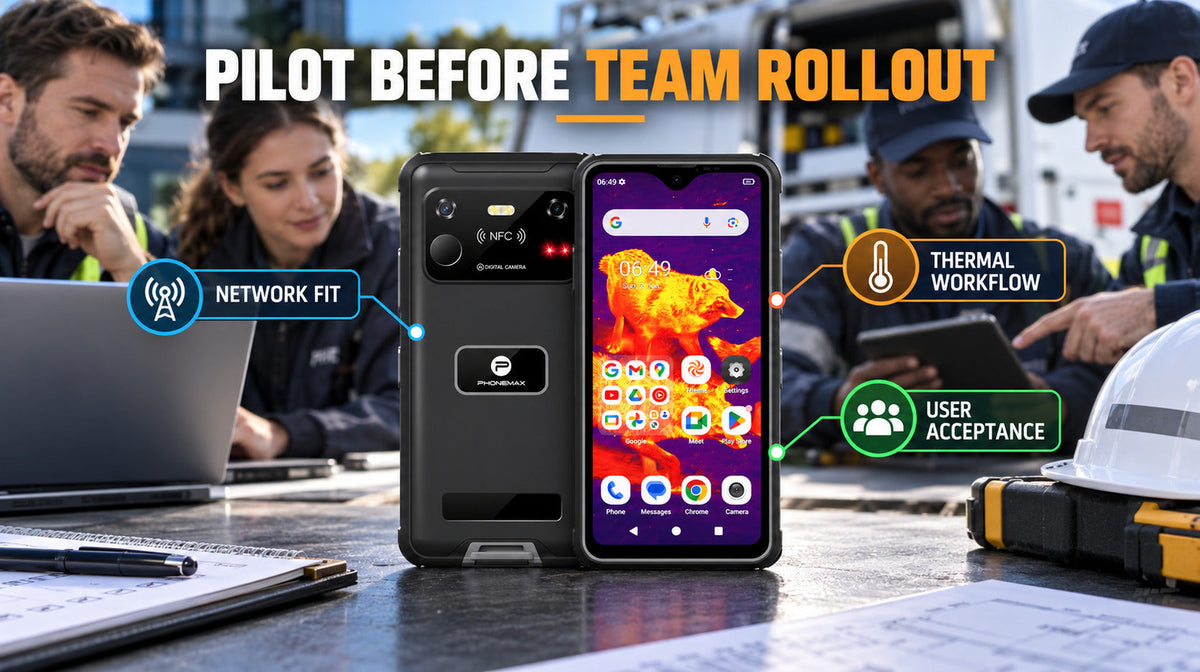
Start with a small pilot across representative roles and include the most demanding site, not only the average one. A rollout decision on a thermal-imaging rugged phone fails or succeeds on three things that no specification sheet answers: whether your carrier's bands hold up where your crews actually work, whether the imaging output is good enough for the specific thing your team needs to see, and whether the device survives your particular abuse pattern. Everything else — procurement terms, MDM, accessories — is straightforward once those three are settled.
Last reviewed: 5 September 2026.
Key facts: what you are evaluating
| Evaluation area | What to verify | How to settle it |
|---|---|---|
| Network bands | R4 GT published 4G/3G/2G bands vs your carrier's actual deployment | Pilot units on real sites, including known weak-signal locations |
| Imaging fitness | Whether thermal and night vision resolve your target at your working distance | Side-by-side capture against a known reference on real jobs |
| Physical fit | 121 x 59.2 x 18.3 mm, 190 g with gloves, in your mounts, in your pockets | Full-shift use by actual crew, not a desk test |
| Durability | Survival under your specific failure mode | Long enough to cover normal tasks, difficult sites and more than one shift pattern |
| Software | Your apps, your MDM, your authentication | IT validation in parallel with the field pilot |
| Commercial | Unit price $298; bulk terms, warranty, RMA turnaround, spares | Written quotation before the pilot ends |
The R4 GT is a compact 4G rugged phone combining thermal imaging and night vision, listed at $298 in Orange and Gray. A "buy two, get one watch free" variant is listed at $596. Its published 4G, 3G and 2G bands are on the product page and must be checked against your carrier.
Why a specification review is not an evaluation
Most failed device rollouts pass the specification review comfortably. They fail in month two, for reasons that were visible in week one to anyone actually holding the device.
The recurring pattern: procurement compares datasheets, selects on price and feature count, orders eighty units, and discovers that the crews cannot operate the camera wearing the gloves the safety policy mandates. Or that the site with the worst coverage — the one that generated the request in the first place — is on a band the device does not support well. Or that the thermal output is fine for finding a hot bearing but useless for the actual task, which was reading a gauge in the dark.
None of these appear on a datasheet. All of them appear within a week of real use. A pilot is cheap; at $298 per unit, five pilot devices cost less than the administrative time spent debating the purchase.
Stage 1: Define the trigger task
Before ordering pilot units, write down the one task that justifies buying imaging-equipped phones at all. Be specific to the point of discomfort.
Not "thermal inspection". Instead: "identify overheating terminals in outdoor distribution cabinets at 1–2 m, during daylight, well enough for the technician to decide whether to escalate."
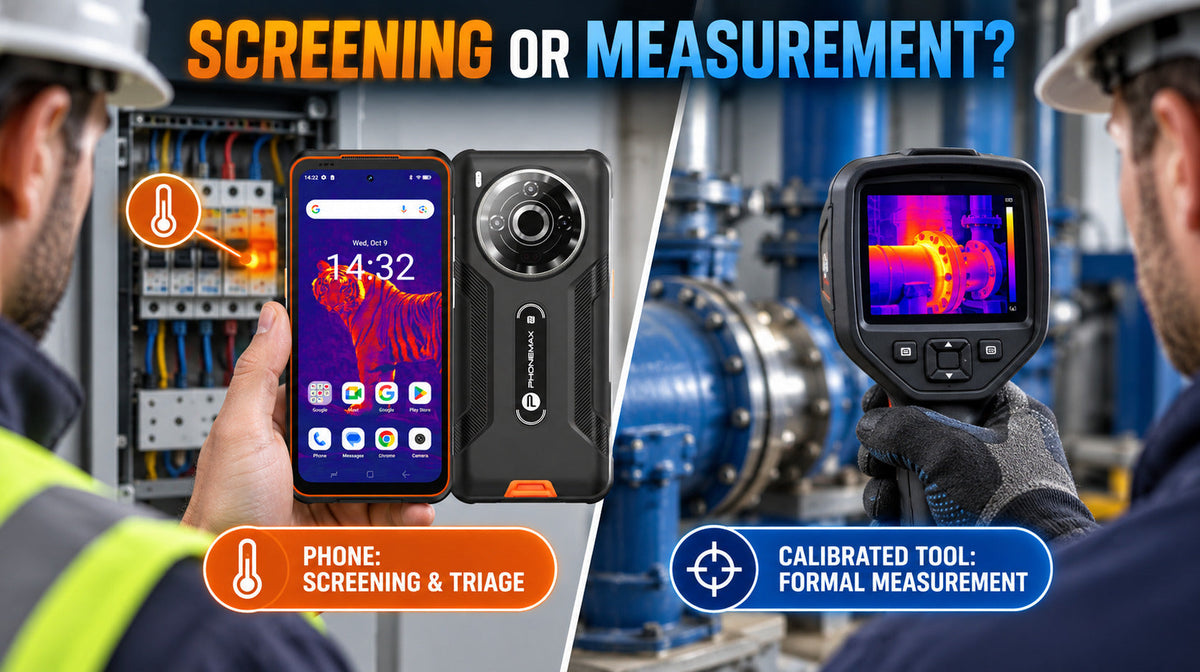
That sentence determines the entire evaluation. It tells you the working distance, the lighting condition, the target size and — critically — that the output feeds a decision, not a report. If your sentence instead ends "...well enough to include the temperature reading in a customer-facing compliance document", the R4 GT is the wrong tool and you should stop the evaluation here. Current product materials state 256 × 192 thermal resolution, a −20°C to 550°C measurement range and ±2°C accuracy, but no traceable calibration provision is stated. If the reading will support compliance, safety or contractual decisions, confirm the required measurement procedure and use a suitably calibrated instrument.
Most field teams discover their trigger task is detection, not measurement. That is exactly what this class of device is for.
Current Phonemax product materials state a 256 × 192 thermal sensor, NETD ≤40 mK, a −20°C to 550°C measurement range, ±2°C accuracy and a 25 Hz refresh rate. These are manufacturer figures, not independent laboratory verification. Root-Nation's independent review also reports a 256 × 192 thermal camera, 20MP night vision, Helio G99, 8GB RAM and rugged ratings for its review unit. If measurement traceability matters, request documentation for the exact units supplied.
Stage 2: Verify bands before you verify anything else
This is the fastest way to kill a bad rollout early.
Compile the list of sites where your crews work, prioritising the ones with known connectivity problems. Obtain the bands your carrier operates at those locations — not the national band list, the local deployment. Compare against the R4 GT's published 4G, 3G and 2G bands.
Then test physically. Carrier coverage maps are marketing artifacts. Take two pilot units to your three worst sites and check whether they hold a usable data connection where the crew actually stands, not in the car park.
If band coverage fails, no other evaluation criterion matters. A device that cannot get data off the site does not solve a field-reporting problem regardless of its camera.
Stage 3: Validate imaging against a known reference
Give pilot users a simple protocol: whenever they use the thermal or night-vision camera on a real job, capture the same scene with whatever they use today — a dedicated imager if you have one, a normal phone camera if you do not — and note whether the R4 GT image was sufficient to make the decision.
Collect the pairs. After four weeks you will have a body of evidence specific to your work, which is worth more than any published specification or review.
Independent third-party coverage is useful context while you plan the protocol. TechRadar's R4 GT review and Root-Nation's R4 GT review both assess the device independently, and there is a teardown video examining repairability that is directly relevant to fleet serviceability. Italian outlet Tecnolovez and Russian technology site iXBT have also covered it. Read them for a sense of the device's character — but they are reviews of a device in general use, not validation against your trigger task.
Stage 4: Physical and human factors
Run this concurrently with imaging validation, using crew who will actually be issued the device.
- Gloved operation. Every control, in the gloves your safety policy requires. This eliminates more devices than any other single test.
- One-handed use. At 121 x 59.2 x 18.3 mm and 190 g, the R4 GT is compact for a rugged phone. Verify this helps rather than hinders — small can mean fiddly with gloves on.
- Mounting. If units go in vehicles, test in your actual mounts before ordering eighty.
- Full-shift carry. Pocket, belt, harness — wherever it will live for eight hours.
- Charging pattern. Whether a shift ends with usable charge, under real usage including imaging.
Log complaints verbatim. Crews will tell you within days what will cause the rollout to be abandoned in month three.
Stage 5: IT and lifecycle questions
Settle these in parallel, in writing:
- Does your MDM enrol and manage the device as expected?
- Do your line-of-business apps install and run correctly?
- What is the Android security-update expectation for the deployment period?
- What is the RMA process, turnaround time and geographic coverage?
- What spares ratio do you need — and can you buy spares at the same terms later?
- What is the warranty term, and what does it exclude?
The last three are procurement questions that field teams routinely forget until the first device fails.
Stage 6: The bulk order decision
Convert the pilot into a decision using the evidence you collected, not impressions. You should be able to answer:
- Did band coverage hold at the worst sites? (Pass/fail — no partial credit.)
- In what proportion of real uses was the imaging sufficient for the decision at hand?
- What did crews complain about, and is it tolerable at scale?
- Did any unit fail, and how was it handled?
- Are commercial terms confirmed in writing?
If imaging sufficiency came in low, before rejecting the device check whether the trigger task drifted towards measurement during the pilot. That is a specification problem on your side, not a device fault, and it means you need a calibrated instrument alongside — not instead of — field phones.
Alternatives to evaluate alongside
Running a comparative pilot costs little more than a single-device pilot and produces a much stronger decision.
If the imaging requirement is thermal but the team needs 5G and a larger screen, evaluate the Phonemax P20 Pro at $479 — a 5G thermal-imaging rugged phone at 172.6 x 81 x 17.8 mm and 394 g. It is more than twice the weight of the R4 GT, which matters over a shift.
If night vision alone would satisfy the trigger task, the Phonemax X3 at $155 provides a night-vision camera plus L1+L5 dual-band positioning at roughly half the R4 GT's price. Confirm first that your task genuinely needs heat detection rather than low-light visibility — these are different sensors solving different problems.
If some crew members need a compact rugged phone without imaging, the Phonemax R4 Mini at $138 shares a similar compact footprint at 121 x 59.5 x 15.5 mm and 150 g. Mixed fleets are legitimate: issue imaging devices to the roles that need them.
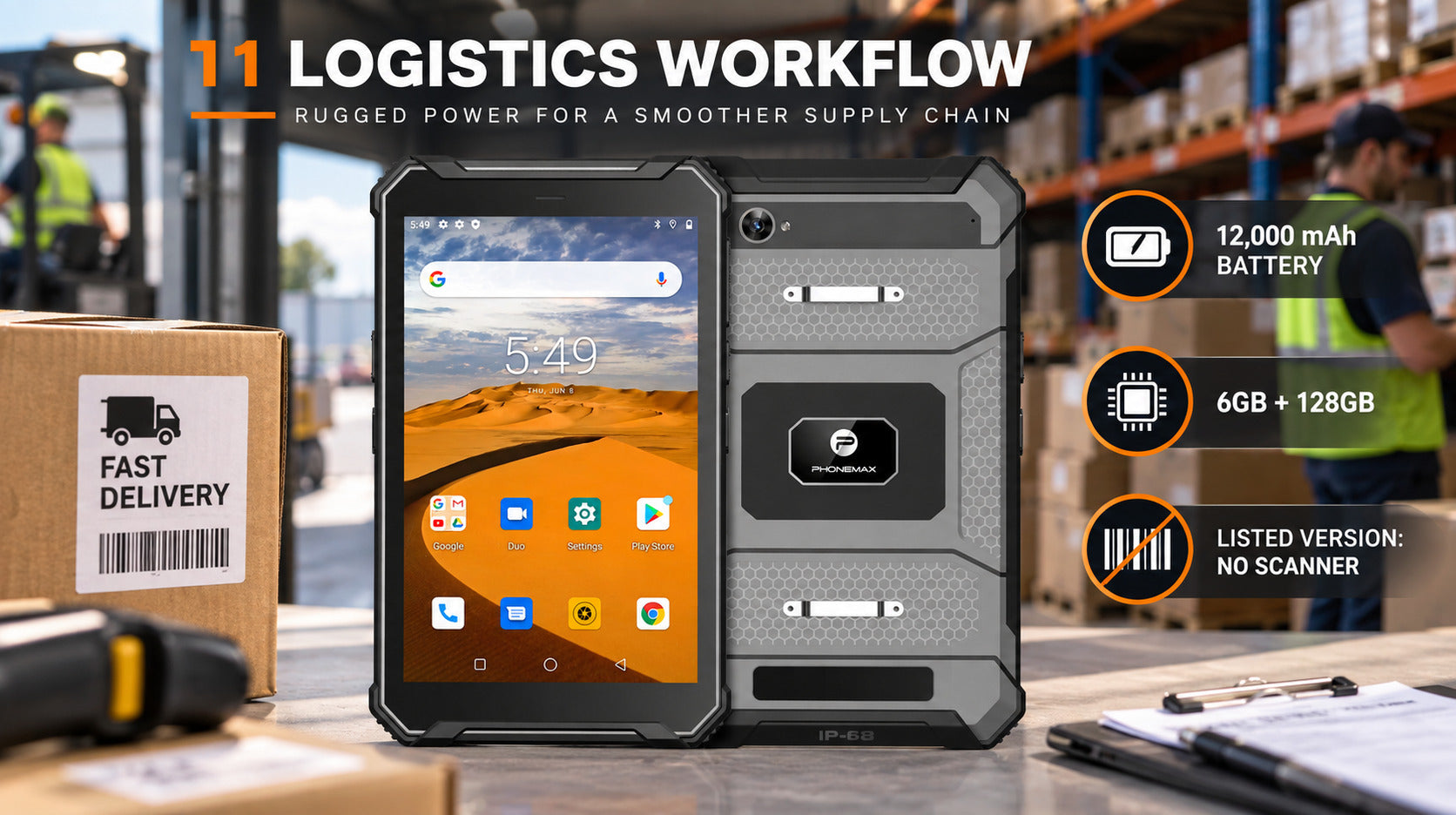
For teams whose primary need is a large screen for documentation rather than imaging, the Phonemax T1 industrial rugged tablet at $299 runs Android 16 with a 12,000 mAh battery and IP68/IP69K protection. Note that the currently listed T1 configuration does not include a barcode scanner; if scanning is part of the workflow, raise that with Phonemax before specifying.
Devices sit in the Thermal Imaging Rugged Phones and Rugged Phones collections.
Limitations and what to know
- Published thermal figures are not the same as calibration traceability. The current materials state 256 × 192 resolution, NETD ≤40 mK, −20°C to 550°C and ±2°C accuracy. Confirm calibration documentation and the required inspection standard before using readings as formal evidence.
- Reviews are not fleet validation. The independent reviews cited above evaluate the device generally. They do not test it against your task, your sites or your carrier.
- Stock and lead time need confirming for volume. Listed availability reflects retail stock, not bulk-order lead times. Confirm both before committing to a rollout date.
- Certification requirements are yours to verify. If your sites require intrinsically safe or explosion-protected equipment, check the device's actual published certifications against your requirement. Do not infer certification from the "rugged" category.
- Pilot duration should follow the workflow. Include enough shifts to cover low-signal areas, gloved use, charging routines and the relevant temperature conditions. A short pilot may be adequate for a narrow task; seasonal risks may require a later follow-up.
- This process assumes a detection use case. If your output is regulated documentation, the evaluation framework above does not apply and you need instrument procurement, not phone procurement.
FAQ
How many pilot units do we need? Use enough units to represent the roles, sites and shifts that can change the decision. A small team may need only a few units, but there is no universal number; every critical workflow should be exercised and every tester should be debriefed.
How long should the pilot run? Long enough to complete normal and difficult tasks across more than one shift pattern. Define exit criteria in advance and extend the pilot if network, weather or workload conditions have not yet been represented.
Can we use R4 GT thermal images in compliance documentation? Do not assume that published accuracy figures alone satisfy a compliance standard. Confirm calibration traceability, procedure and report requirements for the applicable standard; otherwise treat images as indicative screening evidence.
Which rollout risks should be tested first? Start with site-level network coverage, gloved operation, thermal-image usefulness for the defined task, charging and application compatibility. These factors can change a deployment decision and are not resolved by a specification sheet alone.
Should we standardise the whole team on one device? Not necessarily. Mixed fleets by role are common and often cheaper: imaging devices for inspection roles, simpler rugged phones for everyone else.
Is there independent coverage of the R4 GT we can review? Yes. TechRadar, Root-Nation, Tecnolovez and iXBT have all published independent reviews, and a third-party teardown video examines repairability. Links are in the sources section.
Evidence and disclosure
Phonemax publishes this commercial guide and sells the R4 GT. Specifications and availability were checked on 5 September 2026; thermal figures are manufacturer-stated and not independent calibration evidence. The cited reviews and teardown are third-party coverage, but Phonemax selected them. Treat this six-stage framework as a starting checklist and run the pilot with your own network, applications, users and acceptance criteria before a team rollout.
Sources and references
- Phonemax R4 GT product page — manufacturer specifications
- TechRadar, Phonemax R4GT review (independent)
- Root-Nation, Phonemax R4GT review (independent)
- Tecnolovez, Recensione Phonemax R4GT (independent, Italian)
- iXBT Live, Phonemax R4GT coverage (independent, Russian)
- Phonemax R4GT teardown and repairability (independent video)
Evidence boundaries: device specifications are first-party manufacturer data. The five reviews and the teardown video are independent third-party publications, unpaid to our knowledge, but assess general use rather than fleet suitability. No independent laboratory verification of thermal performance is available for this model. The evaluation methodology itself is Phonemax-authored and has not been externally validated.
Related guides
- Phonemax R4 GT vs P20 Pro: Compact Thermal Phone or 5G Thermal Rugged Phone?
- How to Deploy the Phonemax T1 as a Shared Rugged Tablet for Field Teams

Deixar comentário
Os comentários precisam ser aprovados antes da publicação.
Este site é protegido por hCaptcha e a Política de privacidade e os Termos de serviço do hCaptcha se aplicam.