
Price update — October 9, 2026: Prices in this guide were rechecked in USD against the listed product configurations. Prices and availability may change; confirm the selected configuration on its product page before ordering.
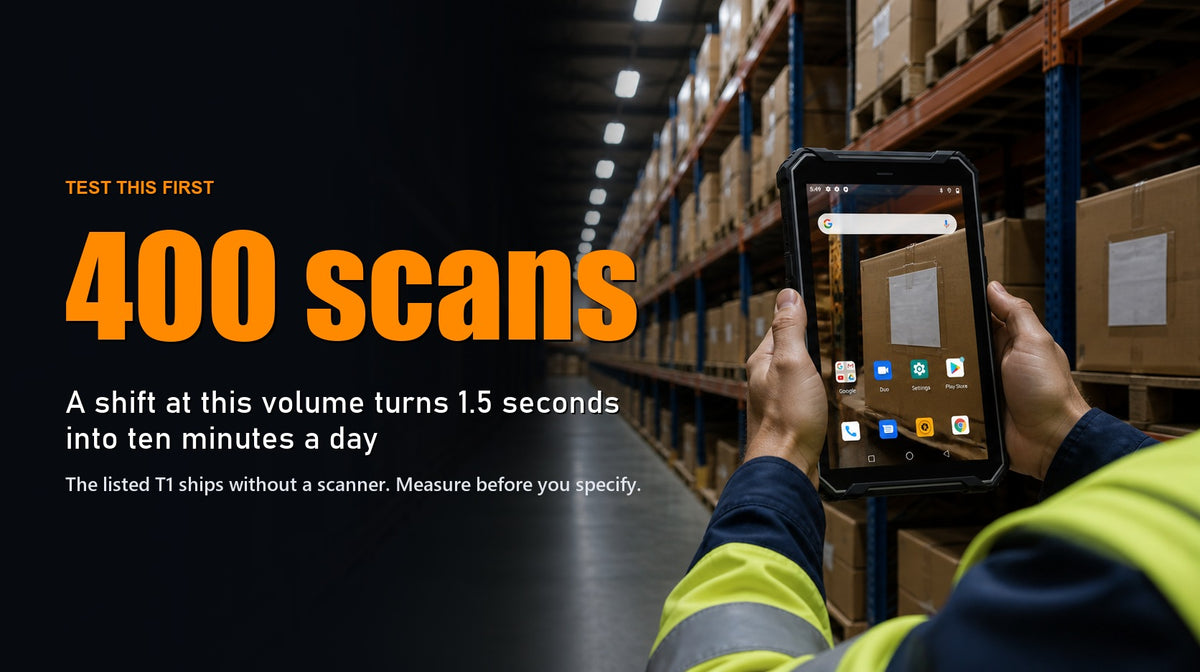
Test the scanning workflow first, because that is the finding that changes the purchase. The listed Phonemax T1 configuration ships without a barcode scanner, so if your operation scans, the single most important thing your evaluation can establish is whether camera-based software scanning is fast and reliable enough at your volume, on your labels, in your lighting. Everything else on the test plan — battery, durability, mounting, apps — matters, but none of it will change the decision the way that one measurement does.
Key facts
| Specification | Phonemax T1 |
|---|---|
| Operating system | Android 16 |
| Processor | MediaTek Helio G80 |
| Memory | 6GB RAM + 128GB storage |
| Battery | 12,000 mAh with 18W charging |
| Protection | IP68 / IP69K |
| Barcode scanner | Not included in the listed configuration |
| Colours | Gray in stock; Green and Orange out of stock |
| Price | $299 |
The listed variant is explicitly labelled "T1: 6GB+128GB Without Honeywell Barcode Scanner". The product URL contains the phrase for historical reasons and does not describe the current specification.
Test 1: Scan rate and failure rate
This is the test that decides the purchase, so run it properly.
Set up realistically. Use your actual labels, including the damaged and scuffed ones — a test on pristine labels is not a test. Use the lighting the work actually happens in. Have the operator hold the tablet the way they will hold it, wearing whatever they wear.
Measure two things:
- Time per scan, from raising the device to the successful read, across at least 50 attempts.
- First-attempt failure rate — how often the code does not read and needs a second try.
Then multiply. If camera scanning averages 1.5 seconds slower per scan than hardware scanning, and your operative performs 400 scans a shift, that is ten minutes a day per person. Across twenty staff over a year that is a real cost, and it is the number a procurement committee actually responds to.
Record the conditions: label type and condition, lighting, distance, angle, operator, gloves, date. A scan-rate figure without those is not evidence.
If the numbers are poor, the conclusion is not that the T1 is a bad tablet. It is that you need a scanner-equipped T1 Pro configuration, which must be specified at order — contact us before proceeding rather than planning to add scanning later.
Test 2: Battery across a real shift
12,000 mAh is a capacity, not a runtime, and no runtime is published.
Define the usage pattern and hold it constant: screen brightness setting, connectivity, camera or scanning volume, applications running. Then record the battery percentage at fixed points — shift start, mid-morning, lunch, mid-afternoon, shift end — for at least five working days.
Record the charge rate too. From a known low level, plug into the charger you will actually deploy and note the percentage every ten minutes for an hour. 18W is stated, but what matters operationally is how much a real break returns.
Test a shared-device day if the tablet will pass between shifts. Two consecutive shifts on one charge is a different test from one shift.
Test 3: Durability, within the rating
IP68 and IP69K describe designed resistance under defined laboratory conditions. Your test should reflect realistic exposure, not exceed the rating and then record the failure as a fault.
- Washdown exposure if your environment has it — with all covers correctly closed, which is itself the thing being tested.
- Drop from working height onto the surface it will actually be dropped onto.
- Cold and heat if your operation spans them.
- Vibration if vehicle-mounted, over a realistic period.
Record what was done and what happened. Photograph any damage.
Test 4: Mounting and physical handling
Frequently the real constraint on a tablet deployment.
- Does it fit your vehicle mounts, and does the mount hold it on rough roads?
- Can it be operated one-handed while standing?
- Signature capture on the screen with a customer holding it — does it work in bright sun?
- Gloved operation of the touchscreen, if gloves are worn.
- Cable routing and strain relief in the mount.
Test 5: Applications and IT
Install every line-of-business application on the actual 6GB/128GB Android 16 configuration and use it in real work.
- Does your MDM enrol and manage it as expected?
- Do the apps render correctly and perform acceptably on the Helio G80?
- What does storage consumption look like after two weeks of real photograph capture?
- Does offline behaviour work where coverage is poor?
How to record it
Same fields, every entry: date, unit identifier, tester, environment (temperature, lighting, wet or dry), battery level at start, the test performed, the measurement, and a plain-language note.
"Scanning is slow" is not evidence. "Camera scan averaged 2.8 s vs 1.1 s on existing hardware scanner across 50 reads; 6 first-attempt failures on scuffed labels; warehouse aisle lighting; unit A; 14 Nov; J. Okafor" is a sentence a procurement committee can act on.
Summarise against the decision, not the device: not "the T1 is good", but "for proof-of-delivery work at under 50 scans per shift, camera scanning added negligible time and battery covered two consecutive shifts; for warehouse picking at 400+ scans, camera scanning added an estimated 10 minutes per operator per shift."
What a complete evaluation produces
A short document containing: the scan-rate comparison with conditions, five days of battery data, durability exposures and outcomes, mount compatibility findings, IT validation results, and a written recommendation split by role — because the honest answer is often "yes for drivers, no for warehouse".
That last point matters. Mixed fleets are normal and usually cheaper than forcing one device into every role.
Comparison: what else to evaluate alongside
If scanning volume is high, the listed T1 is not the right specification. Contact us about a scanner-equipped T1 Pro before proceeding.
If the work is navigation-led, evaluate the Phonemax N1 at $509 — same 12,000 mAh battery, 18W charging and Android 16 platform, adding GPS, GLONASS and Galileo positioning plus reverse charging.
If a phone would serve better than a tablet, the Phonemax P2 at $191 offers a published 6100 mAh battery, 8GB RAM, 128GB storage, IP68/IP69K protection and a 21MP camera for photographic documentation.
If teams cross carriers, the Phonemax M10 at $169 publishes a broad 4G band list — with our own caveat that a broad band set does not guarantee compatibility with every carrier.
Compare within the Industrial Tablets and Rugged Tablets collections.
Limitations and what to know
- The listed configuration has no barcode scanner, and the product URL misleads on this. Restated because it is the fact most likely to invalidate an evaluation built on the wrong assumption.
- The scanner-equipped P1 Pro is not currently available for purchase. Do not plan a scanning workflow around it without confirming availability with us directly.
- Battery runtime is not published. Only capacity.
- IP68 and IP69K are laboratory test conditions, and protection depends on covers being correctly closed.
- Two of three colours are out of stock. Only Gray is currently available.
- The Helio G80 is a mid-range processor — fine for logistics applications, not for heavy analytics.
- Bulk lead time differs from retail stock status. Confirm separately.
- No independent third-party review of the T1 exists that we are aware of, so your own testing is the only independent evidence that will exist.
FAQ
Does the Phonemax T1 include a barcode scanner? No. The configuration currently listed for sale is explicitly labelled "Without Honeywell Barcode Scanner". The product URL contains the phrase for historical reasons. Contact Phonemax before ordering if you require a scanner-equipped T1 Pro.
How do I test whether camera scanning is good enough? Measure time per scan and first-attempt failure rate across at least 50 reads, using your real labels including damaged ones, in your actual lighting. Then multiply the per-scan difference by your daily scan volume to get the operational cost.
How long does the 12,000 mAh battery last? Runtime is not published. Define a usage pattern, hold it constant, and record battery percentage at fixed points across at least five working days.
How many evaluation units do we need? Two or three for most operations, covering the distinct roles that would receive the device. The value is in measured data from real work, not in unit count.
Can we test the IP rating ourselves? Not meaningfully — IP ratings are laboratory-defined tests. Test realistic exposure your operation actually involves, with all covers correctly closed, rather than attempting to replicate the standard.
What if results differ by role? That is a normal and useful finding. Recommend by role rather than forcing one device across the whole operation; mixed fleets are often cheaper.
Publisher disclosure
This article is published by Phonemax and is commercial content. Every product recommended is one we sell, and the article's purpose is to support a B2B purchase decision.
Specific to this article: we are the vendor supplying the test protocol for our own product, and the first and most heavily weighted test in that protocol is one this product can fail. If your scan volumes are high, the honest outcome of Test 1 is that the listed T1 is the wrong specification. We have said so in the opening paragraph rather than letting a buyer discover it after a bulk order.
This is the third article in this series to restate that the listed T1 ships without a barcode scanner while its URL says otherwise. That repetition is deliberate. The URL is our error, it is genuinely misleading, and a procurement buyer who assumes scanning is included would build an entire evaluation on a false premise.
We have also disclosed that the scanner-equipped P1 Pro is not currently purchasable, because recommending an unavailable product as the solution would be worse than useless.
Battery runtime is not published for this device — only capacity — which is why Test 2 asks you to measure rather than trust a figure. And no independent third-party review of the T1 exists that we are aware of, which means your own evaluation will be the only independent evidence about this device in existence. That is a weak position for a buyer and we would rather say so than imply a body of validation that does not exist.
All specifications and stock figures are manufacturer-stated, read from our live product pages on 2 September 2026. The evaluation methodology is Phonemax-authored, has not been externally validated, and produces internal decision evidence rather than publishable measurement. No customer supplied a case study, and no paid or sponsored review is cited.
Sources and references
- Phonemax T1 product page — manufacturer specifications and current variants
- Phonemax Industrial Tablets collection
- Phonemax N1 product page — shared-platform comparison
- Shenzhen Phonemax Technology, Norwegian VOEC register entry (independent government record)
Evidence boundaries: all T1 specifications and stock figures are first-party manufacturer data with no independent product testing available for this model. No battery runtime figure exists in any source and none is stated here. The scan-time comparison figures used as worked examples are illustrative, not measured on this device. The VOEC register entry is an independent government record verifying the company's cross-border tax registration, not product performance. The evaluation methodology reflects general procurement practice rather than a validated testing standard.
Related guides
- How to Deploy the Phonemax T1 as a Shared Rugged Tablet for Field Teams
- Phonemax T1 vs N1: Industrial Rugged Tablet or Rally Navigation Tablet?
- IP68 vs IP69K vs MIL-STD-810H: What Should Rugged Phone Buyers Actually Care About?


Deixar comentário
Os comentários precisam ser aprovados antes da publicação.
Este site é protegido por hCaptcha e a Política de privacidade e os Termos de serviço do hCaptcha se aplicam.